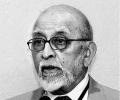
M R Srinivasan focused on the peaceful use of nuclear power at a time when the popular view among the 'hawks' was that India should build a nuclear arsenal as a deterrent.

The enduring relationship between the two countries have survived the disintegration of the erstwhile USSR in 1991, the end of the Cold War and the regime change in both countries, points out Rup Narayan Das.

Although the credit for acquiring the technological skill must be given to India's outstanding nuclear scientists, the decision to go nuclear was a political one that entailed clarity of vision, courage and resolve, points out Rup Narayan Das.
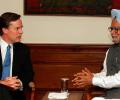
The India-US nuclear deal was aimed at ending India's nuclear isolation and nuclear apartheid, recalls Rup Narayan Das.
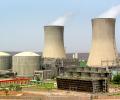
'Chinese are going bang, bang, bang building 30-35 reactors.' 'We should announce a programme of 50 new reactors and show that we mean business on the ground and not just announcements.'

The European Union is following with great interest India's discussions with the International Atomic Energy Agency on the civilian nuclear agreement and will take a decision on supporting India at the Nuclear Suppliers Group after studying all the developments.

With the spectre of nuclear terrorism growing, the international community is concerned about the security of India's nuclear facilities. The worry has grown since 2010, when radioactive Cobalt-60 surfaced in a New Delhi scrapyard, killing one person and hospitalising eight others.

'If not, we can become frighteningly chaotic, more chaotic than what we are today.' 'In today's environment in the country, we still have a window of opportunity.'
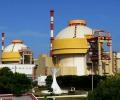
'Decisions on nuclear power have so far been taken by a small select group, primarily interested in profiteering from their actions, stating 'secrecy' as necessary from the national security point.' 'This argument is false, because we are dealing with the 'civilian' nuclear power sector, which is open even to the IAEA,' says Dr A Gopalakrishnan, former chairman of the Atomic Energy Regulatory Board.
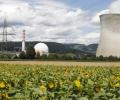
'We need uranium to fuel our reactors. Our scientists and engineers have been handling uranium safely since 1967. They must not feel disheartened by the activities of well motivated local or foreign agencies.'

The government must justify why we need to buy foreign reactors when we have developed up to 700 MWe unit-size pressurised heavy water reactors, a design which can be easily extended to 900 to 1000 MWe unit size. Why can't the 'Make in India' philosophy apply to indigenous nuclear reactors, more than 18 of which have been designed, built, and being operated by Indian engineers, asks Dr A Gopalakrishnan.

'The prioritisation of groups for COVID-19 vaccine shall be based on two key considerations -- occupational hazard and risk of exposure to infection, and the risk of developing severe disease and increased mortality'

'The India-Canada relationship has suffered benign neglect. Its full potential has not yet been realised,' says Rup Narayan Das.
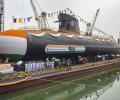
The status of the current submarine force level is alarming and we need to address the threat perceptions expeditiously. Critical decisions pertaining to national security cannot be delayed any further due to the rapidly changing maritime threat perceptions and growing strategic importance of the Indian Ocean region, asserts Commodore Venugopal Menon (retd).

The biological weapons convention is a non-starter in spite of the efforts of many states in the world for the last five decades mainly because the US is not ready to accept the 'verification protocol' which could allow the formation of some official mechanism for inspections, says Ajay Lele.

Prime Minister Modi felt there were too many silos with no arrangement to take a comprehensive view on national security. The PM has entrusted NSA Ajit Doval to evolve a comprehensive roadmap and get it implemented, reveals Nitin Gokhale, Editor-in-Chief, Strategic News International.
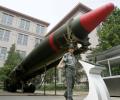
Despite four disarmament section talks and six strategic dialogues between the two foreign ministries, China's intransigence on recognising Indian nuclear status resulted in no confidence building measures in the nuclear field between the two, says Srikanth Kondapalli.

India has built two top-secret facilities in Karnataka to enrich uranium in pursuit of its hydrogen bomb dream.

'If it weren't for Om Puri, a whole range of our big city experiences wouldn't have found their honest representations on the screen.'
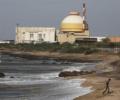
The first two units of the Kudankulam nuclear plant will discharge 6.3 billion litres of waste water every day right onto the beach. This discharge will trigger a slow-motion disaster that will poison beaches, devastate near-shore fisheries and choke the livelihood of fisherfolk in the vicinity, says Nityanand Jayaraman.

Prime Minister Narendra Modi and United States President Barack Obama will meet on Sunday, January 25, at Hyderabad House a few hours after the American leader's arrival in New Delhi.

'The unique achievements have been made by engineers from small towns who have had a non elite upbringing and who have grown with the programme,' says R Aravamudan, one of the pioneers of the Indian space programme.

20 years ago this day, May 11, 1998, India conducted its second nuclear test at Pokharan in Rajasthan. In a fascinating interview on Rediff.com, K Subrahmanyam revealed how Indian PMs reacted to nuclear ambitions.

This is the joint statement issued by the ministry of external affairs on the visit of US President Barack Obama to India.

It's your diet that holds the key to a fulfilling sex life. Boost libido by changing what you eat.

Describing India as an "emerging democratic superpower", Australian Prime Minister Tony Abbott on Thursday kicked off his two-day India visit during which the two countries are likely to clinch an elusive civil nuclear deal.
Big ticket defence deals including purchase of missile systems, frigates and joint production of helicopters were sealed on Saturday.

Let's take a look at the doomsday scenarios:

A sensational interview on India-China ties, with the man most qualified to answer.
